
Why infrastructure shapes liquidity resilience, more than products
Modern capital markets are shaped less by mispricing and more by liquidity, particularly when liquidity cannot move fast enough. Repos and collateral are central to understanding this reality.
The current article argues that the next phase of market resilience will come more from upgrading the plumbing that governs settlement, margin, and intraday liquidity, where distributed ledger technology (DLT) is already delivering measurable results.
What do we mean by DLT in this context?
- In this article, DLT is not treated as a new asset class or a replacement for existing market institutions.
- It is a data and settlement framework that allows multiple parties to see the same transaction state, at the same time, with a high degree of certainty without relying on post-trade reconciliation.
- DLT enables participants to agree on the what, when and the current state of a transaction, using cryptographic verification and distributed record-keeping. This shared record becomes difficult to alter retroactively and reduces the operational frictions that arise when each party maintains its own version of the truth.
- Used selectively, this capability has important implications for settlement timing, collateral mobility, and intraday liquidity management.
What are Short-term liquidity instruments?
These are tools institutions use to manage liquidity, funding, and balance sheet over very short horizons, typically overnight to a few months. They are about cash management , not investment return.
In practice, they fall under four buckets
- Secured funding instruments — most favoured especially post-crisis such as repos, stock lending / borrowing, collateralised Commercial Papers,
- Unsecured funding instruments — less important post-crisis but still used such as Interbank loans, i.e., overnight loans, Certificate of Deposit or CDs, Commercial Paper or CPs,
- Central Bank Liquidity Tools such as standing facilities, open market operations, central bank repos
- Very short-dated instruments used as liquidity stores such as treasury bills, money market fund units.
This classification is based on economic function and reflects how the IMF, BIS, and central banks describe money markets in practice.
Repos tend to be the first focus because they are cash-driven, intraday-sensitive, and systemically visible whilst securities lending sits on the same collateral infrastructure and is a natural second-order use case once settlement and margin rails are in place.
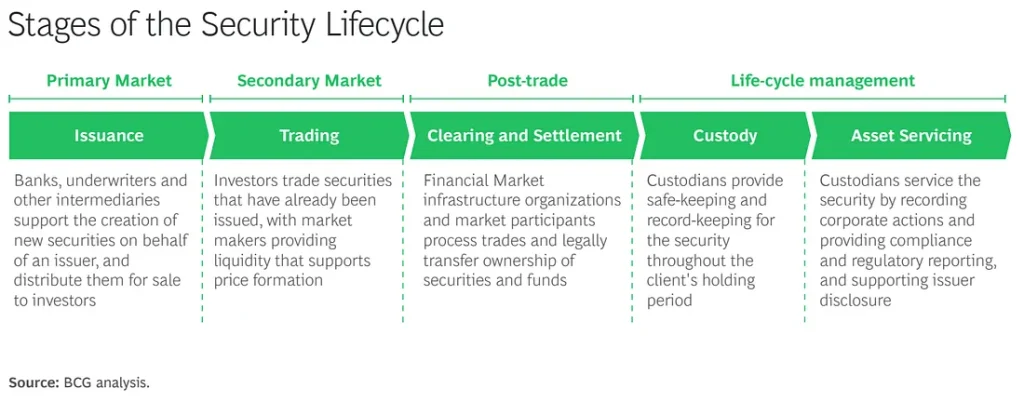
Mapping of a Security’s Lifecycle
Before focusing on repos specifically, it is worth stepping back to look at the broader securities lifecycle. The diagram below is not intended as a process walkthrough, but as a way of highlighting where time, handoffs, and operational friction quietly accumulate across execution, settlement, custody, and collateral management. These frictions — rather than asset risk — are what increasingly bind liquidity in modern markets.
Why do Repos matter in global finance?
Repos are the circulatory system of capital markets. They provide secured funding, support market-making in government bonds, enable leverage and deleverage without asset sales, and underpin margining in derivatives. When repo markets function smoothly, liquidity flows and confidence holds. When they don’t, stress propagates rapidly across asset classes.
Despite their importance, a significant proportion of repos, including overnight repos, are still governed by deferred settlement cycles. This creates a structural mismatch between how liquidity is needed intraday and how collateral actually moves operationally.
Collateral is Infrastructure
Collateral is often discussed tactically in terms of eligibility schedules, haircuts, or margin calls. Strategically, it is market infrastructure.
Across repos, securities lending, and OTC derivatives, institutions rely on collateral to:
- manage counterparty credit risk
- meet regulatory liquidity and capital requirements
- access short-term funding
- support clearing and settlement processes
Post-crisis reforms have dramatically increased the volume of collateral held across the system. Yet collateral management remains fragmented across desks, custodians, triparty agents, and clearing houses, limiting visibility and mobility precisely when speed matters most.
Where today’s repo and collateral markets fall short
Despite their scale, repo and collateral markets still suffer from structural inefficiencies that are well documented across industry studies:
- Deferred settlement (T+1 / T+2) keeps collateral stuck even for short-dated repos
- Fragmented custody and triparty chains require physical movement of collateral across multiple intermediaries
- Limited lifecycle visibility, with poor real-time insight into pledged, reusable, and unencumbered assets
- Manual margin and substitution processes, particularly in bilateral markets
- Intraday liquidity blind spots, forcing institutions to prefund buffers and over-collateralise positions
These frictions inflate balance-sheet usage, increase operational risk, and amplify stress during volatile periods rather than absorbing it.
The real opportunity of DLT in repo markets
Tokenization is often framed as a way to create new assets. In repo and collateral markets, its real value lies elsewhere.
DLT enables collateral to become:
- digitally represented with clear ownership records
- transferable with embedded settlement logic
- visible across the lifecycle in near real time
- movable intraday without relying on physical custody chains
This is not about reinventing repos. It is about upgrading how collateral moves.
On-chain Settlement: A Complementary Layer
DLT-based settlement is not intended to replace existing clearing houses, custodians, or central securities depositories. Its strength lies in acting as a complementary settlement channel for specific transaction types where precision and speed matter most.
Repos and collateral movements are particularly well-suited because they depend on:
- settlement certainty
- margin timing
- intraday liquidity availability
Targeted deployment avoids the capital inefficiencies that would arise from forcing all assets into real-time settlement.
Atomic Delivery-Vs-Payment (DvP)
Repos are conditional exchanges: cash against collateral today, reversed at maturity. Atomic DvP ensures that cash and collateral move together — or not at all.
By eliminating settlement risk and reducing fails, atomic DvP is not just an efficiency gain. It is a material risk-management improvement, particularly during periods of market stress.
Real-Time Margining and Intraday Liquidity
Margining today is largely an end-of-day construct applied to an intraday risk environment. DLT enables margin to be treated as a continuous lifecycle process:
- real-time exposure calculation
- automated variation margin calls
- intraday collateral substitution
- faster release of excess collateral
The result is freed collateral, tighter intraday liquidity management, and reduced reliance on conservative buffers.
The Repo & Collateral Lifecycle: Where DLT actually delivers value
- Traditional lifecycle (simplified) Execution → Deferred settlement (T+1 / T+2) → Collateral trapped → End-of-day margin → Delayed release at maturity
- DLT-enabled lifecycle Execution → Atomic DvP settlement → Intraday collateral reuse → Real-time margining → Automated maturity release
By compressing time, synchronising records, and automating controls, DLT shifts collateral from a static regulatory buffer into an actively managed liquidity resource.
Evidence from live market infrastructure
These outcomes are already visible in production:
- Industry analysis consistently identifies repos and OTC derivatives as priority candidates for DLT adoption due to their reliance on collateral mobility and margin precision.
- Deferred settlement is shown to trap collateral and inflate liquidity buffers, even for overnight funding.
- Shared-ledger models act as a golden source for trade and collateral status, reducing reconciliation breaks and operational bottlenecks.
- Production platforms such as J.P. Morgan’s intraday repo infrastructure and Broadridge’s Distributed Ledger Repo demonstrate atomic DvP, near-zero settlement fails, and repo transactions measured in hours rather than days — while operating within existing triparty, custody, and legal frameworks.
- Books-and-records models such as HQLAx show how collateral substitutions and transformations happen instantly without moving securities through traditional custody chains.
What this means for Institutions
- DLT delivers the most value when deployed as infrastructure, not as a product overlay
- The largest gains come from time compression, visibility, and automation, not new asset formats
- Infrastructure-first adoption improves balance-sheet efficiency without changing underlying risk profiles
Repos and collateral are key to building liquidity resilience and this is where the next phase of market evolution is already shaping up.
Reference
- https://www.gfma.org/wp-content/uploads/2025/08/1.-full-report-impact-of-dlt-in-cap-mkts-final-1.pdf (Impact of DLT in Capital Markets by Boston Consulting Group)
- https://www.oecd.org/content/dam/oecd/en/publications/reports/2025/01/tokenisation-of-assets-and-distributed-ledger-technologies-in-financial-markets_be149012/40e7f217-en.pdf?utm_source=chatgpt.com (Tokenization of Assets and DLT in Financial Markets)
- https://www.iosco.org/library/pubdocs/pdf/IOSCOPD809.pdf (Tokenization of Financial Assets by the International Organization of Securities Commissions)
P.S.
In case the cover image caught your attention, then you should definitely check out my website and my IG account for similar artworks. I’m a multi-award winning abstract textured artist known for my unique palette knife technique. Listed as a Bestseller on Singulart, a France-based renowned online art gallery.
https://www.singulart.com/en/artist/gaya-chandrasekaran-62057?show_popin=subscribe
Artist Bio
Gaya Chandrasekaran is a London-based contemporary artist. Born in the coastal city of Chennai, India, her artistic practice is deeply influenced by the vivid colors and rich cultural heritage of her upbringing. Her textured acrylic works, layered with palette knives and gilded with gold leaf, evoke depth, movement, and emotion, inviting viewers into a contemplative space of memory, nature and transcendence. She has trained in India and at the Slade School of Fine Art in London.
Her practice has been recognised internationally with multiple awards, the VAA Art100 International Art Prize, the Collectors Art Prize | Art Legends of Our Time and the Persona Art Honours.
Gaya’s artworks have been exhibited widely across the UK, US and Europe, with features in prominent art publications. Her paintings have been reviewed by Tabish Khan, a renowned art critic and are held in private collections across the US, UK, Spain, Italy, Brazil, and India, with a permanent display at London Business School.
Through her abstract landscapes, Gaya explores themes of shared human experience, the inner voice of contemplation (Soliloquy), cycles of transformation (Rebirth), and the pursuit of spiritual growth (Nirvana). Her paintings serve as a visual meditation on nature and the profound emotional terrain of life itself.
Originally published at https://www.linkedin.com.