
Why time compression is the real balance-sheet unlock
Liquidity in modern markets is not constrained by asset availability. It is constrained by time. Settlement cycles, margin mechanics, and operational cut-offs dictate how much of the balance sheet institutions must hold idle. This article argues that settlement should be understood not as a back-office function, but as a balance-sheet management tool — and that targeted use of distributed ledger technology (DLT) is already compressing time in ways that materially change balance-sheet economics.
This relationship is not theoretical. The Depository Trust & Clearing Corporation (DTCC) has estimated that shortening settlement cycles can materially reduce margin requirements purely through time compression. In its analysis of a move from T+2 to T+1 settlement, DTCC estimated that the volatility component of clearing margin requirements could fall by up to 41%, without any change in underlying risk exposure (Source: U.S. SEC Release №34–94196, 2022).
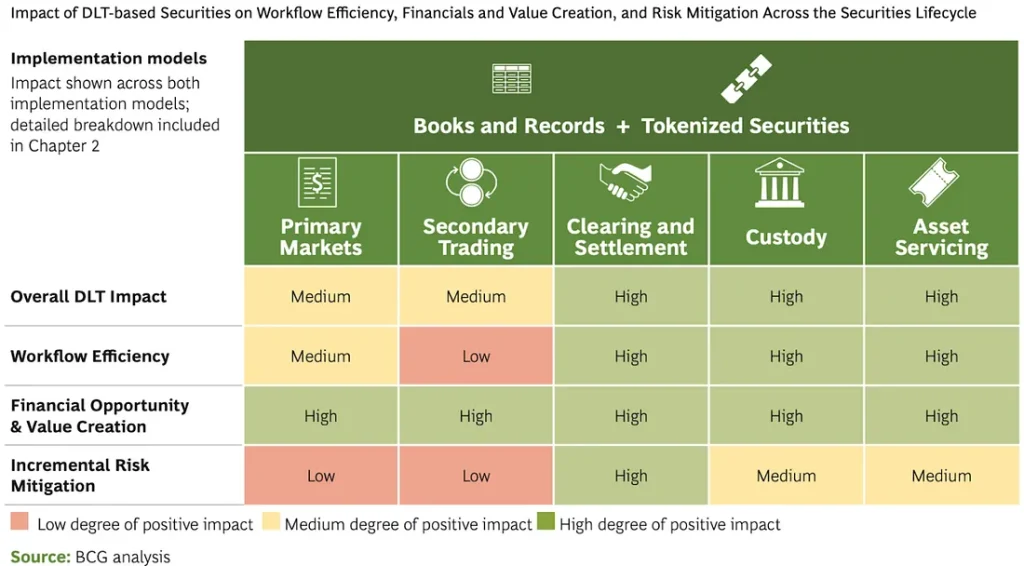
The diagram below highlights the level of impact of DLT-based Securities on workflow efficiency, financials and value creation and risk mitigation across the Securities lifecycle. The high impact with respect to post-trade processes (i.e., clearing & settlement) positively affects liquidity across the securities lifecycle. The chart shows where time, reconciliation, and operational handoffs accumulate and why settlement mechanics increasingly shape balance-sheet usage.
European regulators have made this linkage explicit. In its assessment of shorter settlement cycles, the European Commission noted that faster settlement directly reduces settlement and replacement-cost risks, while also lowering the need for margin (Source: European Commission, Shortening the EU settlement cycle, 2025).
Liquidity is a timing problem
When markets seize, it is rarely because assets disappear. It is because assets cannot be mobilised quickly enough to meet obligations.
Across repos, derivatives, and collateralised funding markets, institutions face a familiar mismatch:
- liquidity is required intraday
- settlement and collateral movement occur later
- buffers are built to bridge the gap
Those buffers consume balance sheets, inflate funding costs, and become stress amplifiers during volatility.
Operational stress becomes most visible during transitions. Ahead of the U.S. move to T+1 settlement, industry estimates suggested that settlement failures could rise from 2.9% to 4.1% as firms adjusted processes and liquidity buffers, a reminder that liquidity strain often reflects infrastructure readiness rather than asset risk (Source: Reuters, May 2024) .
What settlement actually does to balance sheets
Settlement determines:
- how long assets remain encumbered
- how long cash is unavailable for reuse
- how large prefunding and liquidity buffers must be
Even modest delays compound. A ‘T+1’ or ‘T+2’ settlement cycle may look operationally acceptable, but economically it forces institutions to carry liquidity against exposures that no longer exist in risk terms but only in process terms. This is not a pricing problem. It is an infrastructure problem.
Why repos expose the issue most clearly
Repos sit at the intersection of funding, settlement, and collateral. They are therefore the clearest lens through which to view settlement as a liquidity tool. Despite a large share of repos being overnight or shorter-dated, traditional settlement mechanics prevent institutions from:
- accessing funding exactly when needed
- reusing collateral intraday
- releasing assets immediately once exposure ends
The result is excess balance-sheet usage for short-lived risk.
Time compression changes the economics
When settlement occurs with precision, the economics change. DLT-enabled settlement allows:
- pre-defined settlement and maturity times
- atomic delivery-versus-payment
- intraday settlement measured in hours, not days
This compresses the margin period of risk, reduces replacement cost exposure, and shortens the duration for which the balance sheet is consumed. Time, in effect, becomes programmable.
Industry analysis of live deployments shows that DLT-based settlement can support repo transactions that span hours rather than days, materially shortening the margin period of risk (Source: GFMA / BCG, The Impact of Distributed Ledger Technology in Capital Markets, 2025).
From buffers to precision
Traditional liquidity management relies on buffers because processes are imprecise.
As settlement becomes more precise:
- prefunding requirements fall
- excess margin can be released sooner
- intraday liquidity can be actively managed rather than passively held
This is why settlement speed is not about “real-time everything”. It is about choosing where precision matters. Repos and collateral movements are prime candidates.
Why this is regulator-aligned
Importantly, compressing settlement time does not weaken risk controls. It strengthens them.
Shorter settlement cycles:
- reduce principal and replacement cost risk
- lower settlement fails
- improve transparency for supervisors
In practice, regulators aren’t trying to replace existing infrastructure; they’re focused on how DLT-based settlement can sit alongside what already works.
Evidence from production environments
Live market deployments already demonstrate that:
- intraday repo settlement can be executed safely within existing legal frameworks
- atomic settlement materially reduces settlement fails
- precise settlement timing improves intraday liquidity management
These are not proofs of concept. They are operational tools being used in production today.
In production environments, DLT-based platforms have demonstrated the ability to settle repo transactions within minutes , while remaining compatible with existing triparty, custody, and legal structures (Source: GFMA / BCG, Deep Dives: Impact of DLT in Capital Markets, 2025). Examples of scaled adoption cited in industry studies include platforms operated by J.P. Morgan Kinexys and Broadridge Distributed Ledger Repo , both focused on intraday settlement efficiency and collateral mobility.
What this means for institutions
Viewing settlement as a liquidity tool leads to different decisions:
- settlement speed is optimised by transaction type, not ideology
- infrastructure investment is justified by balance-sheet efficiency, not novelty
- time compression becomes a source of competitive advantage
In capital-constrained markets, the ability to reclaim hours — not basis points — increasingly defines resilience.
Conclusion: Time is Balance Sheet
Liquidity is not just about what you hold. It is about when you can use it.
As settlement becomes more precise and programmable, institutions that treat time as a first-class economic variable will carry less idle balance sheets, respond faster in stress, and operate with greater confidence.
The future of liquidity management is not faster markets everywhere, it is smarter settlement where it matters most.
Reference
- https://www.gfma.org/wp-content/uploads/2025/08/1.-full-report-impact-of-dlt-in-cap-mkts-final-1.pdf (Impact of DLT in Capital Markets by Boston Consulting Group)
- https://www.oecd.org/content/dam/oecd/en/publications/reports/2025/01/tokenisation-of-assets-and-distributed-ledger-technologies-in-financial-markets_be149012/40e7f217-en.pdf?utm_source=chatgpt.com (Tokenization of Assets and DLT in Financial Markets)
- https://www.iosco.org/library/pubdocs/pdf/IOSCOPD809.pdf (Tokenization of Financial Assets by International Organization of Securities Commissions)
- https://www.sec.gov/files/rules/proposed/2022/34-94196.pdf (U.S. SEC — Release №34–94196 (DTCC margin impact of T+1))
- https://finance.ec.europa.eu/news/t1-settlement-2025-02-14_en (European Commission — Shortening the EU Settlement Cycle (2025))
- https://www.reuters.com/markets/us/wall-street-braces-faster-trade-settlement-2024-05-28/ (Reuters: Wall Street braces for faster trade settlement (May 2024))
P.S.
In case the cover image caught your attention, then you should definitely check out my website and my IG account for similar artworks. I’m an abstract textured artist known for my unique palette knife technique.
https://www.singulart.com/en/artist/gaya-chandrasekaran-62057?show_popin=subscribe
Artist Bio
Gaya Chandrasekaran is a London-based contemporary artist. Born in the coastal city of Chennai, India, her artistic practice is deeply influenced by the vivid colors and rich cultural heritage of her upbringing. Her textured acrylic works, layered with palette knives and gilded with gold leaf, evoke depth, movement, and emotion, inviting viewers into a contemplative space of memory, nature and transcendence. She has trained in India and at the Slade School of Fine Art in London.
Her practice has been recognised internationally with multiple awards, the VAA Art100 International Art Prize, the Collectors Art Prize | Art Legends of Our Time and the Persona Art Honours.
Gaya’s artworks have been exhibited widely across the UK, US and Europe, with features in prominent art publications. Her paintings have been reviewed by Tabish Khan, a renowned art critic and are held in private collections across the US, UK, Spain, Italy, Brazil, and India, with a permanent display at London Business School.
Through her abstract landscapes, Gaya explores themes of shared human experience, the inner voice of contemplation (Soliloquy), cycles of transformation (Rebirth), and the pursuit of spiritual growth (Nirvana). Her paintings serve as a visual meditation on nature and the profound emotional terrain of life itself.
Originally published at https://www.linkedin.com.